
Blood Sugar Control and Safe Ordering Guide for Diabetes: Chipotle Meals (2026)
Managing diabetes while eating at fast-casual restaurants is challenging. You’re constantly calculating: “Will this spike my blood sugar? How much insulin do I need? Is this safe for my A1C?”
The reality: Most fast-food chains make diabetes management nearly impossible. But Chipotle? Chipotle meal is actually one of the safest fast-casual options for people managing diabetes.
Here’s why: Unlike pizza, burgers, or fried chicken, Chipotle lets you control every ingredient. You can build meals specifically designed for stable blood sugar and minimal glucose spikes.
In this comprehensive guide, we’ll show you:
Important disclaimer: This guide is informational. Always consult your endocrinologist or diabetes care team before making dietary changes. Your individual needs may differ based on your type of diabetes, medications, and health status.
UNDERSTANDING DIABETES & BLOOD SUGAR
What Happens When You Eat
For people without diabetes: You eat carbs → Blood sugar rises → Pancreas releases insulin → Blood sugar normalizes.
For people with diabetes: You eat carbs → Blood sugar rises → Your pancreas can’t produce enough insulin (Type 1) or your body resists insulin (Type 2) → Blood sugar stays elevated → Hyperglycemia (high blood sugar).
The Goal: Minimize Blood Sugar Spikes
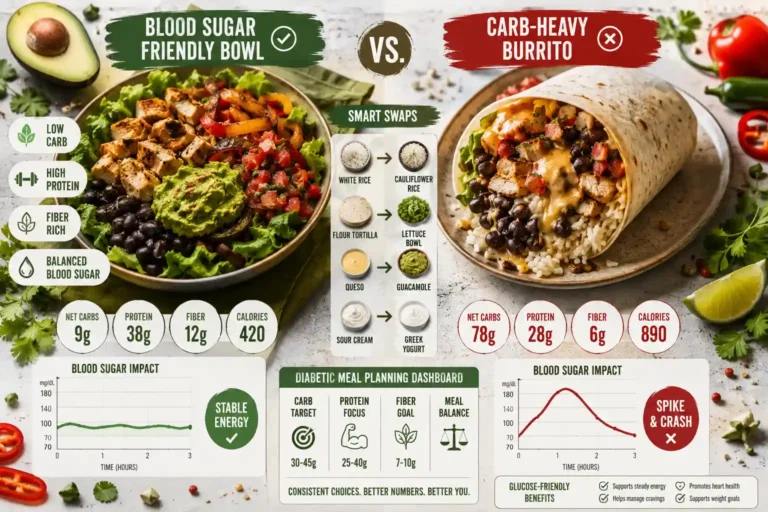
Blood sugar impact depends on three factors:
- Total carbohydrates (grams of carbs = most direct impact)
- Glycemic index (how quickly carbs raise blood sugar)
- Fiber content (fiber slows carb absorption)
The Glycemic Load Formula:
Glycemic Load = (Glycemic Index × Carbohydrates) ÷ 100Example:
- White rice: GI=73, 40g carbs = GL of 29 (moderate)
- Brown rice: GI=68, 36g carbs = GL of 24 (slightly lower)
- Beans: GI=31, 23g carbs = GL of 7 (low)
For diabetes management: Lower GL = smaller blood sugar spike = better control.
Use our diabetes-friendly calculator to build meals within your carb targets and see exact nutrition facts in real-time.
WHICH CHIPOTLE Meals ITEMS ARE SAFE FOR DIABETES?
Safe Proteins (Minimal Blood Sugar Impact)
All Chipotle proteins are safe from a carb perspective:
| Protein | Carbs | Impact | Best For |
| Chicken | 0g | No impact | Standard choice |
| Steak | 0g | No impact | BEST choice (leanest) |
| Barbacoa | 0g | No impact | Good option |
| Carnitas | 0g | No impact | Fine, but high fat |
| Sofritas (Tofu) | 4g | Minimal | Vegan option |
| Carne Asada | 0g | No impact | Good option |
Why proteins are safe: Protein has minimal impact on blood sugar. It doesn’t trigger insulin response like carbs do.
Safe Bases (Choose Carefully)
Carb content varies dramatically by base:
| Base | Carbs | Fiber | Net Carbs | Safe? |
| Salad (romaine) | 2g | 1g | 1g | ✅ YES |
| Burrito bowl | 0g | 0g | 0g | ✅ YES |
| Soft corn tacos | 35g | 3g | 32g | ⚠️ MAYBE |
| Soft flour tortillas | 40g | 2g | 38g | ❌ NO |
| Crispy tacos | 45g | 3g | 42g | ❌ NO |
For diabetes: Choose salad or bowl (zero carbs from base).
Safe Carb Sources (The Tricky Part)
White rice vs Brown rice:
| Item | Carbs | GI | GL | Fiber |
| White rice | 40g | 73 | 29 | 0g |
| Brown rice | 36g | 68 | 24 | 4g |
| Black beans | 23g | 31 | 7 | 8g |
| Pinto beans | 21g | 32 | 7 | 6g |
GL Analysis: Brown rice + beans = GL of 31 (combined). White rice = GL of 29. Not huge difference, BUT beans provide fiber which slows absorption.
For diabetes: Choose beans over rice, or skip rice entirely.
High-Risk Items to Avoid or Limit
Items that spike blood sugar:
| Item | Problem | Carbs | Impact |
| Corn salsa | Added sugar | 16g carbs per 1/4 cup | HIGH |
| Cilantro-lime rice | Some carbs/fat | 40g | MEDIUM |
| Guacamole (standard serving) | High fat (can affect insulin resistance) | 8g | LOW but fat concern |
| Queso Blanco | Sodium + sat fat | 1g | LOW |
| Sour cream | Saturated fat | 1g | LOW |
Red flag foods: Corn salsa has added sugar. Even though serving size is small, each spoonful adds carbs. Limit to 2-3 spoonful.
See our complete nutrition facts breakdown for all Chipotle items.
BUILDING A DIABETIC-FRIENDLY CHIPOTLE MEAL
Step 1: Choose Your Base (Most Important Decision)
For blood sugar control, choose:
- Salad with romaine (2g carbs total)
- Burrito bowl (0g carbs from base)
Why salad is better: The massive volume of low-carb lettuce fills you up without carbs. This is psychological and physiological satiety.
Running total: 0-2g carbs
Choosing the right base is critical. See our complete burrito vs bowl comparison analysis.
Step 2: Choose Your Protein
All proteins are safe. Choose based on:
- Steak: Leanest (lowest saturated fat)
- Chicken: Most commonly ordered
- Carnitas: If you want extra satisfaction (higher fat)
For diabetes + heart health concerns: Choose steak or chicken (lower fat).
Running total: 0-2g carbs
Step 3: Choose Your Carb Source (Critical)
Option A: Beans Only (RECOMMENDED)
- Black beans: 23g carbs, 8g fiber = 15g net carbs, GL=7
- Pinto beans: 21g carbs, 6g fiber = 15g net carbs, GL=7
- This is your best choice (high fiber slows absorption)
Option B: Brown Rice + Beans
- Brown rice (light): 18g carbs, 2g fiber = 16g net carbs
- Black beans: 23g carbs, 8g fiber = 15g net carbs
- Combined: 31g net carbs, GL=24 (higher, but manageable)
Option C: White Rice Only (Not Recommended)
- White rice: 40g carbs, 0g fiber = 40g net carbs, GL=29
- Skips benefits of fiber (impacts absorption rate)
Option D: No Rice, No Beans (Lowest Carb)
- 0g carbs from rice/beans
- Best for extremely tight control or Type 1 with limited insulin
Recommendation for most Type 2 diabetics: Black or pinto beans only (15g net carbs, high fiber, GL=7)
Running total: 17-19g net carbs (from base + beans)
Step 4: Add Vegetables (Free, Safe, Encouraged)
All vegetables are safe:
| Vegetable | Carbs | Benefit |
| Fajita veggies | 4g | Fiber, vitamins, volume |
| Lettuce | 1g | Zero impact, volume |
| Tomato salsa | 3g | Lycopene, low impact |
| Green salsa | 3g | Capsaicin (metabolism boost) |
| Corn salsa | 16g | LIMIT – avoid if possible |
Ask for: Double fajita veggies + both salsas + extra lettuce.
Running total: 20-22g net carbs
Step 5: Toppings Strategy (Manage Saturated Fat)
For people with diabetes, managing saturated fat is important (increases heart disease risk).
Limit these:
| Topping | Sat Fat | Recommendation |
| Cheese | 9g per serving | SKIP for heart health |
| Sour cream | 6g per serving | SKIP |
| Guacamole | 3g per serving | OK in moderation (1-2 tbsp) |
Add these instead:
| Topping | Benefit | Carbs |
| Hot salsa | Flavor without calories | 0g |
| Lime juice | Flavor + may improve insulin sensitivity | 1g |
| Cilantro | Flavor + potential detox support | 0g |
For richness: Small guac on side (2 tbsp = 45 cal, 3g fat, minimal carbs).
Running total: 20-24g net carbs, LOW saturated fat
For more detailed information, check out our detailed calorie guide.
COMPLETE DIABETIC-FRIENDLY MEAL EXAMPLES
Meal #1: “The Tight Control” (Lowest Carb)
For Type 1 or insulin-sensitive Type 2:
- Salad base (romaine): 2g carbs, 1g fiber
- Steak: 0g carbs
- Black beans only: 23g carbs, 8g fiber
- Fajita veggies: 4g carbs, 1g fiber
- Tomato salsa: 3g carbs
- No cheese, sour cream, guac
- Hot salsa + cilantro: 0g carbs
TOTALS:
- Total carbs: 32g
- Total fiber: 10g
- Net carbs: 22g
- Glycemic Load: ~10-12 (LOW)
- Sat fat: 2g (EXCELLENT)
- Protein: 32g (from steak + beans)
Blood sugar impact: Minimal spike. Suitable for most insulin doses.
Estimated blood glucose rise: 80-120 mg/dL increase (manageable)
Meal #2: “The Balanced” (Moderate Control)
For Type 2 diabetics with good control:
- Burrito bowl: 0g carbs
- Chicken: 0g carbs
- Brown rice (light scoop): 18g carbs, 2g fiber
- Black beans: 23g carbs, 8g fiber
- Fajita veggies: 4g carbs, 1g fiber
- Tomato salsa: 3g carbs
- Guac on side (2 tbsp): 4g carbs, 2g fiber
- No cheese, sour cream
TOTALS:
- Total carbs: 52g
- Total fiber: 13g
- Net carbs: 39g
- Glycemic Load: ~22-24 (MODERATE)
- Sat fat: 3g (GOOD)
- Protein: 40g (chicken + beans)
Blood sugar impact: Moderate spike. Requires appropriate insulin or medication.
Estimated blood glucose rise: 120-180 mg/dL increase (manageable with medication)
Meal #3: “The Protein Focus” (Lean Mass Preservation)
For diabetics focused on muscle maintenance:
- Salad base: 2g carbs, 1g fiber
- Double steak: 0g carbs
- Black beans: 23g carbs, 8g fiber
- Fajita veggies: 4g carbs, 1g fiber
- Tomato salsa: 3g carbs
- Guac on side (2 tbsp): 4g carbs, 2g fiber
TOTALS:
- Total carbs: 36g
- Total fiber: 13g
- Net carbs: 23g
- Glycemic Load: ~10 (LOW)
- Sat fat: 4g (GOOD – lean steak)
- Protein: 60g (double steak + beans) ← HIGH PROTEIN
Blood sugar impact: Minimal. High protein delays carb absorption.
Protein benefit: 60g protein fills you up, requires less carbs for satiety. For more high-protein options, explore our complete high-protein Chipotle guide.
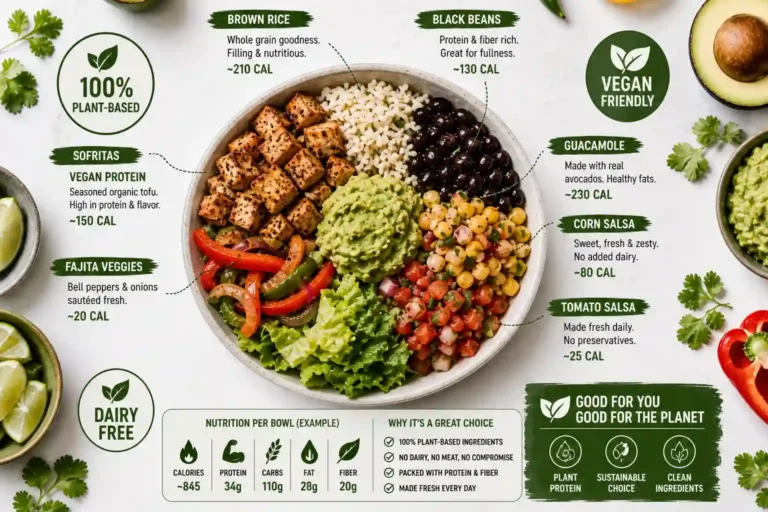
Meal #4: “The Vegetarian” (Plant-Based)
For diabetics preferring plant-based protein:
- Salad base: 2g carbs, 1g fiber
- Sofritas: 4g carbs
- Black beans: 23g carbs, 8g fiber
- Pinto beans (double): 21g carbs, 6g fiber
- Fajita veggies: 4g carbs, 1g fiber
- Tomato salsa: 3g carbs
- Lime dressing: 1g carbs
TOTALS:
- Total carbs: 58g
- Total fiber: 17g
- Net carbs: 41g
- Glycemic Load: ~15-18 (LOW due to high fiber)
- Sat fat: 2g (EXCELLENT)
- Protein: 24g (sofritas + beans)
Blood sugar impact: Despite higher total carbs, high fiber means slower absorption.
Vegetarian benefit: All plant-based protein + plant-based fats (healthier for heart).
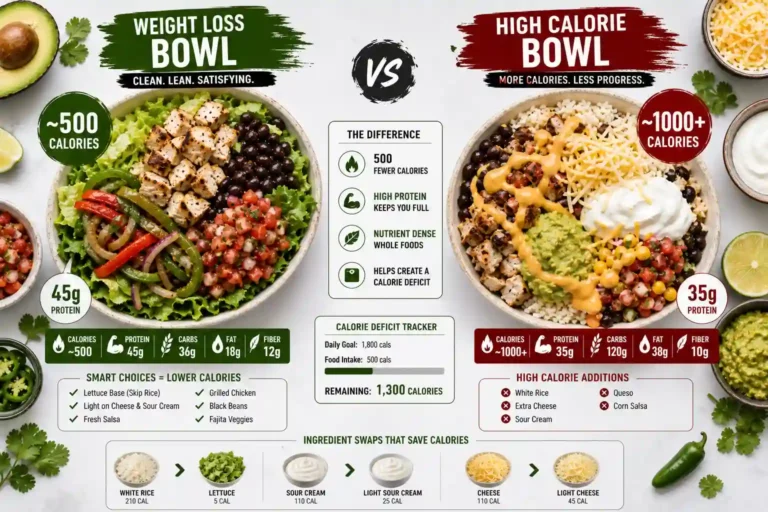
Also understand exactly how many carbs each ingredient adds. See our detailed bowl calories breakdown by ingredient. These principles apply to weight loss too. See our weight loss-focused meals.
BLOOD SUGAR MANAGEMENT STRATEGIES
Strategy 1: Insulin Dosing & Carb Counting
For Type 1 diabetics using insulin:
The meal’s carb count determines your bolus (mealtime insulin dose).
Standard insulin-to-carb ratio: 1 unit insulin per 10-15g carbs (varies by person).
Example for Meal #1 (22g net carbs):
- Carb ratio 1:12 = 22 ÷ 12 = 1.8 units insulin
- Add correction dose if needed
- Total bolus: 1.8-2.5 units depending on current glucose
For Type 2 diabetics: Insulin dosing varies. Consult your endocrinologist.
Strategy 2: Timing (When to Eat)
Best timing: 1-2 hours before activity.
Why: Carbs will be digesting during activity, using glucose for energy rather than causing blood sugar spike.
Example: Eat Chipotle meal at lunch, go for post-lunch walk. Activity uses glucose.
Strategy 3: Pre & Post-Meal Testing
For best control:
- Test before eating (baseline glucose)
- Eat your meal
- Test 2 hours after first bite (peak glucose post-meal)
- Note the impact (how much did it raise?)
Keep a log:
- Meal composition
- Pre-meal glucose
- Post-meal glucose (at 2 hours)
- Insulin/medication taken
- Activity level
Over time: You’ll see patterns. “Salad-based meals raise my glucose 40 points. Rice meals raise it 80 points.”
Strategy 4: Exercise & Activity
Carbs + exercise = better glucose utilization.
- Post-meal activity: Glucose gets used for muscle energy, not blood sugar
- Timing: 10-15 minute walk after eating is ideal
- Duration: Even light activity helps
Science: Muscle contraction increases glucose uptake without requiring insulin. This is called “contraction-mediated glucose uptake.”
WHAT TO WATCH OUT FOR
Watch #1: Hidden Sodium
Chipotle’s sodium content is high:
| Item | Sodium |
| Chicken (1 serving) | 1,380mg |
| Barbacoa (1 serving) | 1,305mg |
| White rice (1 serving) | 1,100mg |
| Black beans (1 serving) | 1,010mg |
| Full bowl total | 4,500-5,000mg |
FDA recommendation: <2,300mg per day.
Diabetes + sodium concern: High sodium = elevated blood pressure = increased heart disease risk (already elevated in diabetes).
Strategy: Order without guac, sour cream, cheese (saves 200-300mg sodium). Ask for salsa instead of other toppings.
Watch #2: Saturated Fat Content
High saturated fat increases insulin resistance:
| Item | Sat Fat |
| Cheese | 9g |
| Sour cream | 6g |
| Guac (full) | 3g |
| Carnitas | 12g |
| Steak | 3g |
| Chicken | 2g |
Diabetes + sat fat: Worsens insulin resistance. Stick to steak/chicken + minimal high-fat toppings.
Watch #3: Sweetened Items
Check corn salsa:
- Labeled as salsa, but contains added sugar
- 1/4 cup = 16g carbs (high for a condiment)
- Skip it or use sparingly (1-2 tbsp max)
INTEGRATING WITH YOUR DIABETES MANAGEMENT PLAN
Working With Your Healthcare Team
Before making Chipotle meal a regular meal:
- Tell your endocrinologist or diabetes educator: “I want to eat at Chipotle regularly. Can you help me build a strategy?”
- Get personalized carb ratio: Your insulin-to-carb ratio might differ from standard
- Discuss timing: When eating fits best with your medication/insulin schedule
- Plan testing: How often should you test with these meals?
- Set alerts: Are there individual items you should avoid based on YOUR health?
Your team knows your:
- A1C level (overall control)
- Type of diabetes
- Current medications
- Other health conditions (kidney disease, heart disease, etc.)
- Individual sensitivities
Personalization matters. This guide is general; your doctor provides specific guidance.
REAL EXAMPLE – BLOOD SUGAR TRACKING
Sarah’s Diabetes Management at Chipotle
Sarah: Type 2 diabetic, on Metformin, trying to lose weight
Meal she ordered:
- Salad base (romaine)
- Chicken
- Black beans only (no rice)
- Fajita veggies, tomato salsa
- No cheese, sour cream, guac
Carb count: 22g net carbs
Testing log:
| Time | Action | Glucose |
| 11:50am | Test before eating | 130 mg/dL |
| 12:00pm | Start eating Chipotle meal | — |
| 1:00pm | Finished eating | — |
| 1:15pm | 15 min post-meal | 145 mg/dL |
| 2:00pm | 1 hour post-meal (peak) | 156 mg/dL |
| 3:00pm | 2 hours post-meal | 142 mg/dL |
| 4:00pm | 3 hours post-meal | 128 mg/dL |
Analysis:
- Rise from baseline: 26 mg/dL (at peak)
- Return to baseline: 3 hours
- Result: Excellent control
Sarah’s conclusion: This meal works for her diabetes management. She can have it 2-3x per week without compromising her A1C.
FAQ – DIABETES & CHIPOTLE
ADDITIONAL RESOURCES & TOOLS
Blood Sugar Tracking Apps
- mySugr: Tracks glucose, carbs, insulin, activities
- Livongo: Connects directly to some glucose meters
- Glooko: Cloud-based glucose management
- Diabetes Buddy: Comprehensive tracking with meal logging
Use with: Take photos of your Chipotle meal before eating. Log carbs. Track glucose response. Build personalized data.
Carb Counting Resources
- American Diabetes Association (ADA): www.diabetes.org/nutrition
- Linus Pauling Institute: Glycemic index database
- USDA FoodData Central: Exact carb counts for foods
Use: Verify carb counts for Chipotle meal ingredients. Double-check portions.
Continuous Glucose Monitoring (CGM)
Consider if: You have Type 1 or insulin-requiring Type 2
Benefits: Real-time glucose data without finger-stick testing. You see exactly how Chipotle meals impact your glucose over 2-3 hours.
Models:
- Dexcom G6/G7
- Freestyle Libre
- Medtronic Guardian
Cost: Covered by most insurance if medically indicated.
IMPORTANT LEGAL DISCLAIMER
This guide is informational only. It does NOT replace professional medical advice.
Before making dietary changes:
Individual differences:
- Type 1 vs Type 2 diabetes = different management
- Medications vary = different carb tolerance
- Complications vary = different dietary needs
- Your doctor knows YOUR specific health situation
This guide: General education
Your doctor: Your specific plan
CONCLUSION
Chipotle CAN be part of a diabetes management plan.
Here’s why:
The key: Choose carefully.
Recommended meal for most Type 2 diabetics:
- Salad or bowl base
- Steak or chicken
- Black or pinto beans (no rice)
- Double fajita veggies
- Tomato salsa
- Small guac on side (optional)
Result: ~20-25g net carbs, 40g protein, minimal glucose spike, excellent satiety.
Before eating: Talk to your healthcare team.
Before ordering: Review our meal recommendations.
After eating: Test your blood sugar to confirm impact.
Your diabetes management is unique to you.
Use Chipotle as ONE tool in your comprehensive diabetes care plan, with your doctor’s guidance.

Wish you happiness
Wish you happiness
Every day is a new beginning
Hahahaha You are so good
Good a blog toper
Here you are
Great post,Thanks for sharing
WZ777Casino está creciendo y se nota. Cada vez tienen más opciones y la atención es mejor. No se lo pierdan, visiten wz777casino.
Yo, check out superjiliapp! Heard it’s the real deal for gaming on the go. Gonna give it a shot tonight, wish me luck!
Wynn09, Alright, I decided to try Wynn09 after seeing some ads, and things are nice here, easy to use. What are you waiting for? It’s here: wynn09
This place has a great vibe and the game selection is top notch. I love the daily rewards and the community feel of the platform. Join the fun at jilibaycasino
I’ve been playing here for a few weeks and the payouts are actually legit. Really smooth experience so far. Check out krcasinowinoui for a great time!
Honestly the best experience I’ve had recently. The games load fast and the payouts are legit. Definitely check out ph65jili if you want some real action!
Thinking of placing a bet on a888bet tonight. Hope my lucky numbers come through! Cross your fingers for me! Place your bets: a888bet
Solid platform with great customer support. They helped me solve my login issue in minutes. Five stars for idcitrabet77.
The most professional betting site I have come across. Everything is transparent and the payouts are prompt. Trust maxbetonline for your gaming needs.
I’ve been trying out a few platforms lately and this one really stands out. The interface is smooth and everything just works. Definitely worth checking out zh88com
Loving the vibe of this place! The bonuses are generous and it feels just like a real casino from the comfort of my home. Give hannonlinecasino a try!
Finally found a site that doesn’t crash during peak hours. The bonuses are actually fair and easy to claim at xin883.
I’ve tried a few different platforms lately, but the access speed here is top notch. Logging in is a breeze every time. Highly recommend bcgamelogin for anyone who hates waiting for pages to load.